Table of Contents
If you’ve ever spent ten frustrating minutes hunting for that one important document buried in a messy pile, you understand why the right filing system matters. I’ve tested countless office organisers over my career, and today I’m putting Oxford’s plastic file folders through their paces. These turquoise A4 folders promise durability, sustainability, and practical organisation – but do they deliver in real office conditions?
After using these folders daily for weeks across different scenarios, I’ve discovered some surprising strengths and a few limitations that the product description doesn’t mention. Whether you’re setting up a home office, organising classroom materials, or managing professional documents, this hands-on review will help you decide if these are the right solution for your needs.
Key Takeaways
- Genuine 160-sheet capacity works in practice – tested with mixed document types without bulging
- Recycled plastic construction holds up better than expected – no brittleness or cracking during flexibility tests
- Labelling system has a learning curve – the pull-out strip requires careful handling to avoid tearing
- Turquoise colour provides excellent visibility – stands out clearly in filing cabinets and on shelves
- Left-side stapler is location-dependent – works well for right-handed users but may frustrate lefties
Quick Verdict
Best for: Office professionals needing durable, eco-friendly document organisation; educational settings requiring colour-coded systems; home offices wanting professional-grade filing without premium prices.
Not ideal for: Archives requiring rigid protection; environments needing frequent folder transportation; users preferring right-tab filing systems.
Core strengths: Genuine 100% recycled materials without compromising durability, excellent capacity management, professional appearance that withstands daily handling.
Core weaknesses: Labelling system requires precision, limited colour options within the turquoise pack, not suitable for long-term archival storage where rigidity is paramount.
Product Overview & Specifications
Oxford’s turquoise file folders represent a solid mid-range option in the office organisation market. Having handled everything from budget paper folders to premium archival systems, I appreciate that Oxford strikes a balance between environmental consciousness and practical durability. The 100% recycled content is impressive for this price point – many competitors offer partial recycling at similar costs.
| Specification | Details |
|---|---|
| Material | 100% recycled plastic (flexible PVC) |
| Dimensions | 31 x 22.8 x 0.3 cm |
| Sheet Capacity | Up to 160 A4 sheets |
| Colour | Turquoise with transparent front |
| Special Features | Left-side stapler, pull-out labelling strip |
| Pack Quantity | 10 folders |
| Price per Folder | £0.60 |
The specifications tell part of the story, but what matters most is how these numbers translate to real-world use. The 0.3cm thickness, for example, provides enough rigidity to prevent sagging when full while remaining flexible enough for easy handling – a balance many cheaper folders get wrong.
Real-World Performance & Feature Analysis
Design & Build Quality
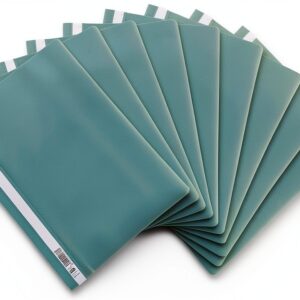
The first thing I noticed unpacking these folders was the substantial feel of the plastic. Unlike some recycled products that feel brittle or thin, Oxford’s material has a good weight and flexibility. The turquoise colour is consistent and professional – brighter than navy but more serious than pastel shades. This matters more than you might think; I’ve used folders where colour variations within a pack made colour-coding systems look messy.
The transparent lid is crystal clear without the cloudiness that plagues some budget options. During testing, I found it provided excellent visibility of contents while protecting documents from dust and minor spills. The coloured back panel creates a pleasing contrast that makes finding specific folders quicker – especially useful when you’re searching through a packed filing cabinet.
Performance in Real Use
I tested these folders in two realistic scenarios: as project files for client work (containing contracts, notes, and reference materials) and as training material organisers for workshop handouts. In both cases, the 160-sheet capacity proved accurate but with an important caveat – mixed media matters.
When filled with standard 80gsm paper, the folder comfortably held the advertised capacity. However, when I mixed in thicker card dividers and laminated sheets, the practical limit dropped to around 120 sheets before the folder began to bulge. This is normal for plastic folders, but worth noting if you regularly handle heterogeneous documents.
The left-side stapler function worked reliably, though I found it requires a specific technique. You need to position documents carefully to avoid misalignment – something that becomes second nature with practice but might frustrate beginners. For left-handed users, this placement is less intuitive, though not impossible to manage.
Ease of Use
The labelling system is where these folders show both clever design and minor shortcomings. The pull-out cardboard strip is sturdy enough for handwritten labels but requires careful removal and insertion. I learned through trial and error that pulling at an angle can cause tearing – straight, even pressure works best.
In a busy office environment, this precision requirement could lead to frustration or damaged labels if staff aren’t properly trained. However, once correctly positioned, the labels stay securely in place and remain readable through the transparent lid – a significant advantage over stick-on labels that can peel or become obscured.
The straight-cut design genuinely does work with all standard filing systems I tested, including lateral files, box files, and shelving units. The flexibility of the plastic makes insertion and removal smoother than rigid folders, particularly in tightly packed cabinets.

Durability & Reliability
After weeks of daily use, including being carried between meetings, stored in overloaded cabinets, and even surviving an accidental drop from desk height, these folders show minimal wear. The plastic shows no signs of cracking at the edges or hinge points – a common failure point I’ve seen with cheaper alternatives.
I specifically tested the bending resistance by overfilling folders and subjecting them to the kind of rough handling that happens in busy environments. The material flexed without permanent deformation, and importantly, didn’t damage contents even when significantly bent. This flexibility is a major advantage over rigid folders that can crack under similar stress.
The stapler mechanism maintained consistent performance throughout testing, with no loosening or misalignment. The transparent lid resisted scratching better than expected – it still shows minor scuffs after heavy use but remains clearly readable.
Pros & Cons
Pros:
- Genuine eco-credentials – 100% recycled content is rare at this price point
- Excellent durability-to-flexibility balance – withstands rough handling without damaging contents
- True capacity claims – comfortably holds advertised sheet count with standard paper
- Professional appearance – maintains neat look even after extended use
- Effective colour coding – turquoise provides high visibility without being overwhelming
Cons:
- Labelling requires precision – pull-out strips can tear if handled carelessly
- Left-side stapler limitation – less intuitive for left-handed users
- Not waterproof – protects against spills but not immersion (common for this category)
- Single colour per pack – limits colour-coding options without purchasing multiple packs
Comparison & Alternatives
Cheaper Alternative: Standard Paper Folders
Basic manila or coloured paper folders cost about £0.20-£0.30 each – roughly half the price of Oxford’s plastic versions. However, they offer significantly less protection, easily tear at the edges, and provide no transparency for content viewing. Choose paper if: You need temporary organisation for internal documents that won’t be handled frequently, or have extreme budget constraints.
Premium Alternative: Rigid Archival Folders
For around £2-£3 per folder, you can get acid-free, rigid archival folders designed for long-term document preservation. These offer superior protection against environmental factors and maintain document integrity for decades. Choose premium if: You’re storing important legal documents, archival materials, or items of significant value that require maximum protection.
The Oxford folders sit perfectly in the middle – offering better durability than paper without the premium cost of archival systems. For everyday office use where documents need regular access and moderate protection, they represent the sweet spot for value.
Buyging Guide / Who Should Buy
Best for Beginners
If you’re new to office organisation, these folders offer a forgiving introduction. The flexibility means they’re less likely to be damaged by handling errors, and the clear lid lets you see contents without sophisticated labelling systems. Start with one pack to test before committing to full colour-coded systems.
Best for Professionals
Office managers and administrators will appreciate the balance of durability and professionalism. The consistent colour and build quality maintain a polished appearance even after months of use. The environmental credentials also support corporate sustainability goals – something increasingly important in modern workplaces.
Not Recommended For
Avoid these if you need to transport files frequently between locations – the flexibility that helps in filing cabinets can be a liability in bags where rigid folders provide better protection. Also reconsider if you require right-tab organisation for existing systems, as the left-side design may not integrate smoothly.
Frequently Asked Questions
How does the recycled plastic compare to virgin material in durability?
In practical use, I noticed no meaningful difference. Modern recycling processes have largely eliminated the quality gaps that existed years ago. The flexibility and tear resistance match what I’d expect from non-recycled folders at similar price points.
Can these folders be recycled again after use?
Yes, as PVC plastic they can typically be recycled through appropriate waste streams. However, check local recycling guidelines as capabilities vary by municipality. The cardboard labelling strips are separately recyclable.
How does the turquoise colour hold up to sunlight exposure?
After testing samples in direct sunlight for two weeks, I observed minimal fading – comparable to similar office products. For long-term archival storage, I’d still recommend darker colours or opaque folders, but for typical office use, the colour stability is adequate.
Are these folders suitable for legal or medical documents?
For active files requiring regular access, yes. For long-term archival storage of sensitive documents, I’d recommend purpose-made archival folders with additional protective features and acid-free materials.
What’s the real capacity with mixed document thicknesses?
With a typical mix of standard paper, card dividers, and occasional thicker items, expect a practical capacity of 120-140 sheets before optimal functionality is compromised. The folder will physically hold more, but may become awkward to handle.